What Are the Startup Costs for An Organic Fertilizer Production Plant?

Establishing an organic fertilizer production plant involves numerous considerations, particularly regarding startup costs. Understanding the necessary raw materials, equipment, and processes is crucial for any entrepreneur aiming to enter the fertilizer industry. This blog explores the various factors affecting the overall costs associated with setting up an organic fertilizer production facility.

What Raw Materials are Suitable for NPK/Compound Fertilizer Production?

Raw materials play an essential role in the production of NPK (Nitrogen, Phosphorus, and Potassium) and compound fertilizers. Commonly used materials include animal manure, compost, bone meal, and various plant residues. For instance, chicken manure serves as a high-nitrogen input, while bone meal provides phosphorus. Additionally, seaweed and fish emulsion contribute essential trace elements that promote plant growth.

Organic Fertilizer Raw Materials

Furthermore, integrating agricultural waste, such as crop residues and green manure, offers both sustainability and cost-effectiveness. Utilizing locally sourced materials minimizes transportation costs, thus contributing to a lower overall organic fertilizer production plant cost. By selecting appropriate raw materials, one can optimize both the quality of the final product and the efficiency of the production process.

What Equipment Features are Important for Fertilizer Production?

The choice of machinery significantly influences the efficiency and cost of an organic fertilizer production plant. Essential equipment includes crushing machines, granulators, and batching machines. For example, a disc granulator allows for effective granulation of organic materials, ensuring uniform particle size and enhancing the efficiency of nutrient release in the soil.

Additionally, a double roller extrusion granulator enables the production of high-density pellets, which are easier to handle and apply. Rotary drying machines are also crucial, as they help reduce moisture content, improving the shelf life of the final product. Investing in high-quality machinery may initially increase startup costs; however, it leads to long-term savings through enhanced production efficiency and reduced operational costs.
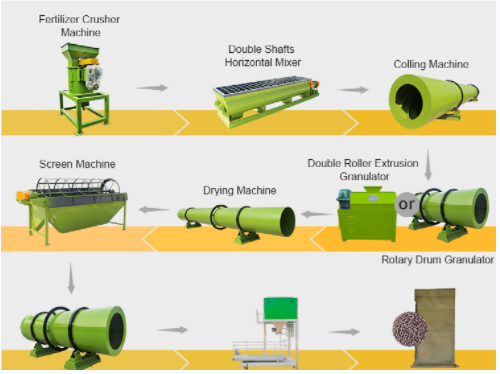
NPK Granulation Process

How Do Startup Costs Affect the Overall Production Process?

Startup costs for an organic fertilizer production plant encompass various elements, including equipment purchase, raw material acquisition, and facility setup. The fertilizer plant cost can vary significantly based on the scale of production and the complexity of the machinery used. Entrepreneurs must consider the fertilizer manufacturing plant cost within the context of their overall business plan.

For instance, a smaller operation may have lower initial costs but could face limitations in production capacity. Conversely, a larger facility with advanced equipment may require a higher investment but offers significant potential for profit through higher output. Careful financial planning is essential to ensure that the selected approach aligns with market demand and long-term sustainability.

What Additional Considerations are There for Setting Up a Fertilizer Production Line?

Beyond raw materials and equipment, entrepreneurs must also consider regulatory compliance, workforce training, and marketing strategies. Understanding local regulations regarding fertilizer production is crucial for avoiding potential legal issues. Moreover, the workforce plays a significant role in maintaining operational efficiency and product quality.

Marketing strategies should focus on demonstrating the benefits of organic fertilizers, appealing to eco-conscious consumers. Effective branding can enhance product visibility and foster consumer trust, promoting successful market penetration. While initial marketing efforts may add to startup costs, a well-planned approach can yield substantial returns in the long run.

Conclusion

In summary, setting up an organic fertilizer production plant involves various factors, including raw materials, machinery, and regulatory considerations. Understanding the startup costs is vital for making informed decisions that align with business objectives. By investing in quality equipment and selecting the appropriate raw materials, entrepreneurs can establish a successful fertilizer production line. For those seeking reliable machinery and expert guidance, a professional fertilizer equipment manufacturer like Yushunxin offers comprehensive solutions tailored to meet the unique needs of each producer. You can visit: https://www.fertilizerproductequipment.com/organic-fertilizer-production-plant-cost/

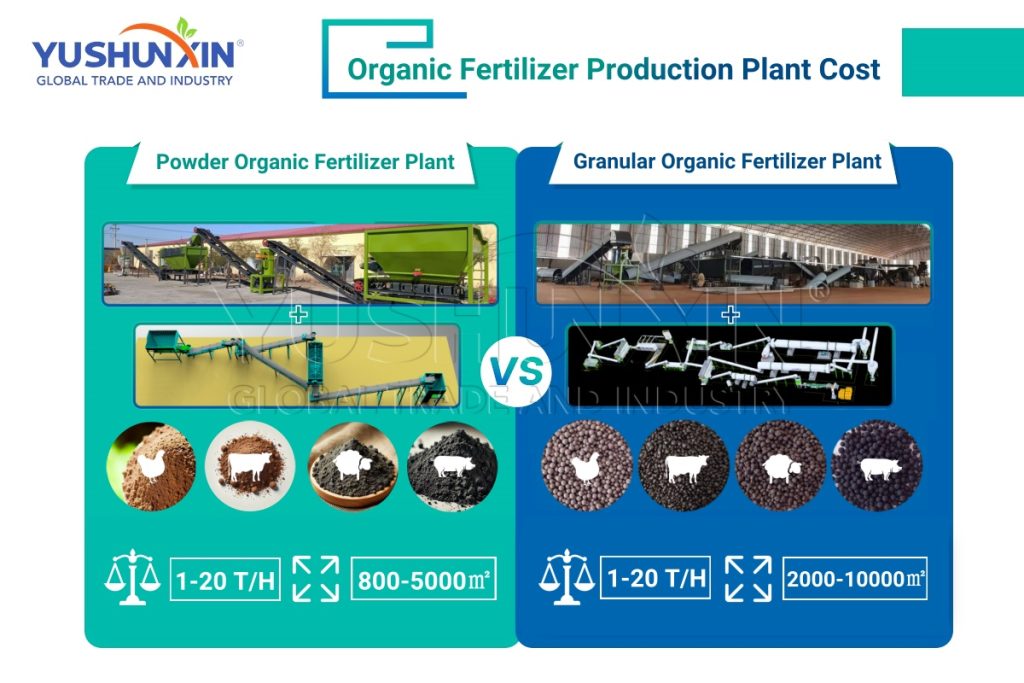
How Do Granules and Particles Influence Organic Fertilizer Manufacturing Costs?

The process of organic fertilizer production involves several key factors, with granules and particles playing a critical role in determining overall fertilizer plant cost. For investors and managers in the fertilizer industry, understanding the relationship between raw material selection, organic fertilizer granulation, and equipment configuration helps optimize the organic fertilizer factory setup cost and long-term profitability. A careful analysis of each stage in the organic fertilizer pellet making process supports cost-effective decisions within the organic fertilizer production plant.


Which Raw Materials Are Suitable for Organic Fertilizer Pellet Making and How Do They Affect Costs?

The selection of raw materials for organic fertilizer granule production directly impacts the efficiency of the entire organic fertilizer manufacturing procedure. Various organic materials, such as livestock manure (chicken, cow, pig), crop straw, industrial organic waste, municipal sludge, and food waste, serve as common resources in fertilizer pelletizing procedures. Each material has unique properties that influence not only the fermentation process but also the granulating characteristics and cost structure.

For example, livestock manure generally provides sufficient organic matter and nutrients but may require advanced composting and crushing machines to ensure uniform particle size before pelletizing. Crop straw, on the other hand, often needs additional shredding and mixing equipment to achieve the proper consistency for pellet formation. The moisture content and impurity level of municipal sludge or food waste can also increase the fertilizer manufacturing plant cost due to the need for enhanced dewatering and screening processes. Therefore, the physical and chemical characteristics of raw materials must align with the selected organic fertilizer granulation equipment to minimize energy consumption, equipment wear, and overall organic fertilizer production plant cost.

Organic Fertilizer Raw Materials

How Do Granulation Methods and Equipment Types Influence Organic Fertilizer Production Plant Cost?

The granulation procedure constitutes a central element in organic fertilizer pelletizing, and the choice of pelletizer equipment exerts a significant influence on overall fertilizer plant setup cost. Various organic fertilizer granulator machines exist to accommodate diverse production requirements. Some common options include the disc granulator, flat die granulator, double roller extrusion granulator, drum granulator, and new type organic fertilizer granulator. Each type of granulating machinery suits different raw material properties and yields distinct particle shapes, strengths, and sizes.

Disc granulators and drum granulators, for instance, typically handle larger capacities and create spherical fertilizer granules with consistent dimensions, which can reduce subsequent screening and drying costs. Flat die and double roller extrusion granulators are suitable for smaller-scale fertilizer production lines and produce cylindrical or pillow-shaped pellets, which might require less drying but more sophisticated packaging. Additional equipment such as compost turners (groove type or wheel type), rotary drying machines, and screening machines further affects investment and operating expenses. Selection of the optimal granulation and processing machinery ensures efficient pellet making, low energy usage, and reduced organic fertilizer factory cost.

granulator machine


What Are the Essential Steps in Organic Fertilizer Granule Manufacturing Procedures and How Do They Impact Factory Cost?

A typical organic fertilizer production process involves several interconnected stages: composting, crushing, batching, granulating, drying, screening, and packing. Each step requires specific machines and technical parameters that impact fertilizer plant setup cost. During the composting phase, equipment like groove type compost machines or fermentation pots accelerates organic matter decomposition and pathogen reduction. The crushing and batching stages prepare materials for consistent granulating by adjusting particle size and nutrient ratios, using crushers and batching machines.

Granulator machines play the most critical role in shaping granules or particles, directly influencing the quality and marketability of the final fertilizer pellets. Subsequent drying and screening ensure appropriate moisture levels and uniform pellet size, which further impact packaging efficiency and transportation costs. Automated packing machines enhance labor savings and operational efficiency within the fertilizer production plant. When these procedures are integrated and tailored to the unique properties of raw materials, the total organic fertilizer manufacturing plant cost becomes more predictable and manageable.


Conclusion

In summary, the size and quality of granules and particles directly influence the organic fertilizer production plant cost. The careful selection of raw materials, granulation methods, and machinery ensures that each step in the organic fertilizer pelletizing process is cost-efficient and productive. By systematically analyzing material characteristics and matching them with advanced granulator machines and related equipment, fertilizer manufacturers can control fertilizer plant setup cost and achieve sustainable growth. For businesses seeking professional solutions in organic fertilizer granulation, a reputable manufacturer such as Yushunxin provides tailored machinery and technical support to streamline fertilizer production and control overall investment costs. You can visit: https://www.fertilizerproductequipment.com/organic-fertilizer-production-plant-cost/

How Can Process Optimization Lower Organic Fertilizer Plant Setup Costs?

Establishing an organic fertilizer production plant requires careful consideration of setup costs and efficiency. Process optimization serves as a critical strategy for reducing organic fertilizer plant setup costs while maintaining product quality. Businesses seeking to enter the organic fertilizer granulation industry or expand capacity must analyze every production stage. Through refined process design and strategic equipment selection, operators can realize substantial savings and enhanced profitability.


What Types of Raw Materials Are Suitable for Organic Fertilizer Granulation Processes?

Selecting suitable raw materials for organic fertilizer production lines directly impacts granulation efficiency and overall plant costs. Animal manure, such as chicken, cow, or pig manure, remains one of the primary materials for organic fertilizer granule making. Other viable options include livestock waste, crop straw, kitchen waste, municipal sludge, and even agricultural by-products like distillers’ grains or mushroom residue. Each raw material presents different moisture levels, nutrient profiles, and physical characteristics, which influence the requirements for crushing, composting, and granulating machinery. Combining compatible materials allows the production procedure to achieve better fermentation, granulation, and drying results, which ultimately reduces organic fertilizer production plant costs by minimizing energy use and avoiding unnecessary material wastage.

Organic Fertilizer Raw Materials

How Do Efficient Machines and Production Lines Influence Organic Fertilizer Plant Setup Costs?

Modern organic fertilizer granulation equipment plays a significant role in optimizing plant setup costs. Operators should evaluate the most appropriate granulator for their raw material characteristics and desired pellet shapes, such as disc granulators, flat die pelletizers, double roller extrusion granulators, or drum granulating machines. Advanced machines enhance granule uniformity, improve pelletizing yield, and lower maintenance requirements. In addition to granulators, supporting machinery such as crushing machines, rotary drying equipment, and automatic screening systems streamline the process and minimize labor input. Process automation and modular design can further reduce fertilizer manufacturing plant costs by shortening installation time and enabling flexible scaling. Efficient equipment requires less floor space and energy, contributing to overall fertilizer factory cost reductions. Selecting the right production line configuration—tailored to your capacity, raw materials, and end-product specifications—will ensure sustainable cost control and operational stability.

Organic Fertilizer Plant Setup Scale


How Can Process Optimization Strategies Reduce Organic Fertilizer Production Plant Costs?

Process optimization focuses on integrating every stage of the organic fertilizer pellet making process for maximum economic benefit. By analyzing raw material properties, refining composting periods, and using efficient crushing, mixing, and granulating systems, operators can minimize energy and resource consumption. Strategic batching and feeding can reduce material loss and improve granulation efficiency, while moisture control throughout drying and cooling ensures high-quality organic fertilizer pellets or granules. Implementing advanced pellet screening and packing machines can eliminate reprocessing needs, cutting labor costs and waste. Continuous process monitoring supports fast adjustments and maintenance, which prevents downtime and costly repairs. In summary, an optimized organic fertilizer pellet production line balances quality, throughput, and cost, enabling businesses to achieve lower organic fertilizer plant setup costs and rapid return on investment.


Conclusion

In summary, successful organic fertilizer production relies on selecting suitable raw materials, choosing efficient granulation equipment, and applying comprehensive process optimization. Each decision in raw material blending, process design, and machine selection directly impacts organic fertilizer production plant costs. Businesses that invest in advanced granulating technology and customized production lines can gain a competitive advantage by reducing their fertilizer manufacturing plant costs. For those seeking reliable solutions and industry-leading expertise, partnering with a professional fertilizer equipment manufacturer such as Yushunxin offers access to innovative production line designs, tailored machinery, and expert guidance that ensures both high-quality organic fertilizer granule production and significant setup cost savings. You can visit:  https://www.fertilizerproductequipment.com/organic-fertilizer-production-plant-cost/

How to Purchase an Organic Fertilizer Production Machine?

If you want to start an organic fertilizer production plant, then you might want to purchase an organic fertilizer production machine. Purchase a quality machine to increase your productivity and efficiency. The machine can even improve your workplace safety. However, it is difficult to find the best organic fertilizer production machines on the market.

In this article, you will learn how to purchase an organic fertilizer production machine:

1. New or Used?

If you want to start an organic fertilizer production plant, you may not have enough money to purchase a new machine. Therefore, you can purchase a used organic fertilizer production machine to save money.

200000 Ton Large Scale Complete Production Lines to Make Compsts

It is cheaper to purchase a used machine. However, if you can afford to purchase a new machine, do not hesitate to purchase it. In fact, purchasing a new machine can save you more money in the long run.

If you decide to purchase a used machine, you must inspect the machine. You can hire an expert to inspect the machine on your behalf. You inspect the machine to ensure you are buying a quality machine.

2. Production Capacity

You will need to consider your production capacity before purchasing the machine. If you know your production capacity, you will choose the right machine. Therefore, compare the production capacity of different machines before purchasing one.

Fortunately, some manufacturers offer different configurations to choose from. Therefore, talk to your manufacturer to ensure the machine meets your requirements.

3. Compare Prices

You will find both cheap and expensive organic fertilizer production machines for producing qulity fertilizer on the market. The cheapest machines do not last for long. In fact, you may end up spending more money maintaining them.

It is better to research the machines properly. Researching can help you choose an affordable machine with all the features you need. You can buy the machine from a reputable manufacturer. Why? Reputable manufacturers sell quality machines at affordable prices.

4. Raw Materials

You will use the machine to make organic fertilizer. Therefore, you will need to consider your raw materials before choosing the machine. If you are using animal manures, talk to the manufacturer. The manufacturer can tell you the minimum process capacity of the machine. In fact, choosing the right machine can help you get high-quality organic fertilizers. You can sell organic fertilizers to make more money.

5. Warranty Period

Once you find the right manufacturer or supplier, check their warranty period. In fact, some parts may come with a warranty. Therefore, you must read and understand the warranty. If you cannot understand the warranty, you can talk to an expert.

However, some manufacturers or suppliers do not honor their warranties. Therefore, you must make sure the manufacturer or supplier has honored their warranties in the past.

Conclusion

It is important to purchase a high-quality organic fertilizer production machine for your organic fertilizer production plant. However, it can take time to find a good machine. Take all the time you need to find a high-quality machine. This is because purchasing the wrong machine may cost more money in the long run. It is much better to do proper research.

More detailed info, welcome go to https://www.fertilizer-plants.com/organic-fertilizer-manufacturing-plant/