What Is the Process of Compacting Lime Powder into Granules Using a Double Roller Press?

Lime powder, derived from limestone or lime rock, plays a crucial role in various industries due to its chemical properties. However, its fine texture can pose challenges in handling, transportation, and application. Converting lime powder into granules enhances its usability and efficiency, particularly in fertilizer production. The double roller press, a specialized machine, provides an effective solution by compacting lime powder into granules without the need for additives. Understanding this granulation process is essential for industries seeking to optimize the use of lime in their operations.

What Raw Materials Are Suitable for Fertilizer Production?

Fertilizer production relies on a variety of raw materials to meet different agricultural and industrial needs. Lime powder is a prime example, offering benefits such as soil pH adjustment and calcium enrichment. Other suitable materials include phosphate rock, which supplies phosphorus; potash minerals, providing potassium; and nitrogen sources like urea. Organic materials like compost and manure also serve as valuable inputs. Each raw material brings specific benefits: for instance, lime granules improve soil structure, while phosphate enhances root development. Selecting the appropriate raw materials ensures that the produced fertilizer meets the nutritional requirements of various crops and soils.

Making Rock Phosphate, Limestone, And Dolomite Pellets by Dry Granulator

How Does the Double Roller Press Granulate Lime Powder?

The double roller press granulates lime powder through a dry extrusion process that compacts the powder into uniform granules. This granulation procedure begins with feeding the lime powder into the machine’s hopper. The powder then moves between two counter-rotating rollers equipped with matching indentations. As the rollers press together, they exert high pressure on the lime powder, causing it to compact and form granules of predetermined sizes and shapes. This method eliminates the need for moisture or binders, preserving the chemical integrity of the lime. The resulting granules exhibit excellent mechanical strength and are suitable for immediate use in fertilizer applications.

What Are the Key Features of the Machinery Used in Lime Powder Granulation?

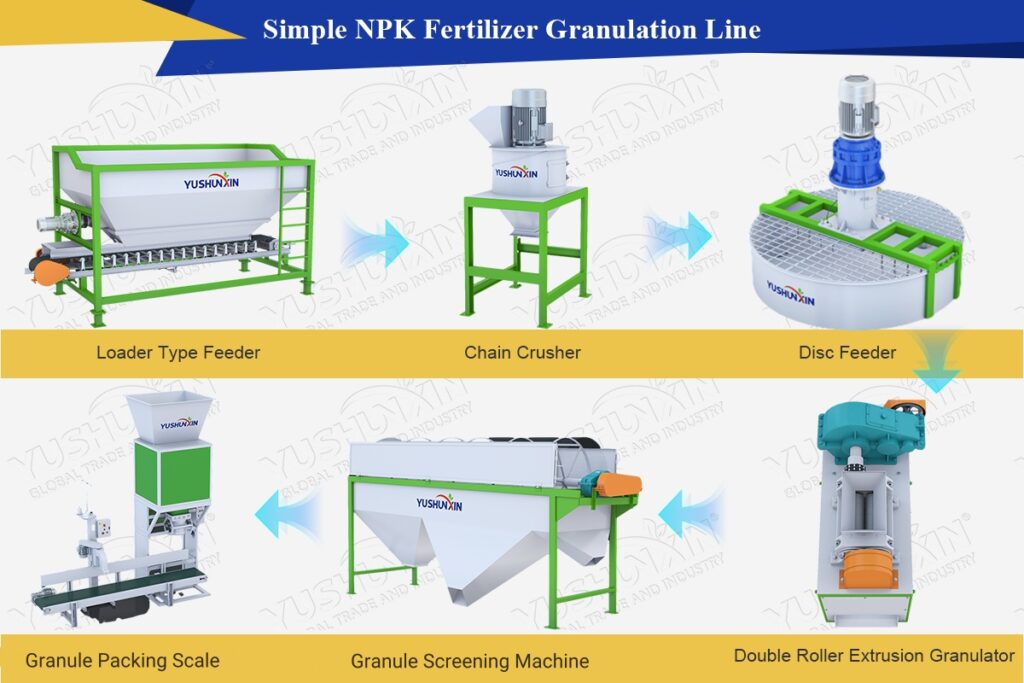
The machinery involved in the lime powder granulation process includes several specialized equipment designed for efficiency and precision. A loader type feeder consistently supplies lime powder to the system, ensuring uninterrupted operation. A chain crusher may be utilized to break down any lumps in the powder, promoting uniformity. A horizontal mixer can blend the lime powder with other additives if necessary. The double roller extrusion granulator serves as the core machine, compacting the powder into granules through dry extrusion. Post-granulation, a rotary screening machine separates qualified granules from fines, which can be recycled back into the process. An automatic packaging scale then measures and packages the granulated product. Belt conveyors connect each piece of equipment, streamlining the entire production process.

Conclusion

The process of compacting lime powder into granules using a double roller press offers significant advantages for fertilizer manufacturing. It enhances the handling, storage, and application of lime, making it more effective for agricultural and industrial uses. The granulation process transforms fine lime powder into durable granules without compromising its chemical properties. Incorporating specialized machinery, such as loaders, crushers, mixers, granulators, and screening machines, ensures a seamless and efficient production line. For industries aiming to optimize their fertilizer production, partnering with an experienced equipment provider is essential. A professional fertilizer equipment manufacturer like Yushunxin can offer the expertise and machinery needed to achieve high-quality lime granulation. You can visit: https://www.extruder-granulator.com/product/limestone-powder-granulation-machine/
How to Produce Limestone Powder Granules?

In the realm of industrial production, the transformation of limestone powder into granules is a process that holds substantial significance. This operation not only facilitates easier handling and application of the material but also enhances its utility in various sectors. This discussion delves into the methodologies and machinery involved in this conversion, aiming to provide a thorough understanding for those interested in establishing an efficient production line.

Understanding the Raw Material: Limestone Composition and Preparatory Steps

Before embarking on the granulation process, one must recognize the characteristics of the primary raw material: limestone. Predominantly composed of calcium carbonate (CaCO3), limestone possesses qualities that necessitate specific preparatory measures. Initial processing involves pulverization to achieve a fine powder state, which serves as the baseline for subsequent granulation. Pre-treatment may also include moisture adjustment and segregation of impurities to ensure an optimal starting material for granulation.

Making Rock Phosphate, Limestone, And Dolomite Pellets by Dry Granulator

The Role of Granulation Equipment in Limestone Powder Processing

Central to the transformation of limestone powder into granules is the deployment of sophisticated equipment. A pivotal machine in this operation is the double roller extrusion granulator, which employs dry granulation technique—bypassing the need for binder materials. This machine exerts pressure on the limestone powder, compacting it into uniform granules. The significance of this equipment lies in its efficiency and ability to produce granules with consistent size and shape, which are crucial for the material’s subsequent applications.

Why Incorporate a Horizontal Mixer and Vertical Crusher in Your Production Line?

For a production line aiming at superior quality limestone granules, the inclusion of a horizontal mixer and a vertical crusher becomes indispensable. The horizontal mixer ensures thorough blending of limestone powder before granulation, promoting uniformity in the final product. On the other hand, the vertical crusher plays a crucial role in size reduction and homogenization of the raw material. These machines, when combined, contribute to a streamlined process flow, enhancing the overall efficiency and output quality of the granulation line.

Simple NPK Fertilizer Granulation Line

Enhancing Production Line Efficiency: The Importance of Equipment Selection

Selecting the appropriate machinery is paramount for achieving an optimal production line for limestone granules. Equipment such as double roller extrusion granulators, horizontal mixers, and vertical crushers should be chosen based on their performance, durability, and compatibility with the limestone processing requirements. Furthermore, attention should be given to the scalability and flexibility of the equipment to accommodate future expansion needs and variability in production demands.

Conclusion

The journey from limestone powder to granules involves meticulous planning, understanding of the material properties, and the strategic deployment of specialized equipment. By prioritizing the selection of high-performance machinery and adhering to best practices in material preparation and process execution, one can establish a robust production line. It is in this context that Yushunxin emerges as a professional manufacturer of fertilizer equipment, offering solutions that cater to the intricate needs of limestone granulation. Their expertise and product offerings represent a valuable asset for those aspiring to excel in the production of limestone granules. You can visit: https://www.extruder-granulator.com/limestone-powder-granulation-machine/

How to use disc pelleting equipment to make limestone granules

Introduction

Limestone granules are a valuable commodity in various industries such as agriculture, construction, and water treatment. To produce high-quality limestone pellets, disc pelleting equipment is commonly used. This equipment is designed to transform powdered limestone into uniform granules through a process of agglomeration and compression. In this passage, we will discuss how to use disc pelleting equipment to make limestone granules effectively.

Preparing the Limestone Powder

Before using the disc pelleting equipment, it is important to prepare the limestone powder properly. The powder should be finely ground and free from impurities. It is also essential to ensure that the moisture content of the powder is within the optimal range, typically between 10-12%, to facilitate the granulation process.

Setting Up the Disc Pelleting Equipment

Once the limestone powder is prepared, the next step is to set up the disc pelleting equipment. The equipment consists of a rotating disc, a feeder, and a scraper. The disc should be set at an angle between 40-50 degrees to ensure proper granulation. The feeder should be adjusted to regulate the flow of the powder onto the disc, while the scraper should be positioned to remove any granules that stick to the disc.

The Granulation Process

The granulation process begins by feeding the limestone powder onto the rotating disc. As the disc rotates, the powder is agglomerated into small pellets due to the centrifugal force. The pellets are then compressed as they roll down the disc, resulting in uniform granules. The granules are then collected at the bottom of the disc and can be further processed or packaged as needed.

Maintenance and Troubleshooting

To ensure the efficient operation of the disc pelleting equipment, regular maintenance is required. This includes cleaning the disc, feeder, and scraper regularly to prevent clogging and buildup of material. Additionally, it is important to monitor the moisture content of the limestone powder and make adjustments as needed to maintain the optimal range. If any issues arise during the granulation process, troubleshooting may be necessary to identify and resolve the problem.

Conclusion

Disc pelleting equipment is an effective tool for producing limestone granules. By properly preparing the limestone powder, setting up the equipment, and following the granulation process, high-quality granules can be produced. Regular maintenance and troubleshooting are also essential to ensure the smooth operation of the equipment. With the right knowledge and techniques, disc pelleting equipment can be used to create a valuable product for various industries. If you want to other limestone powder pelletizer, we can also provide you with the best machines.