What Is the Future of Dry Granulation Technology in Limestone Fertilizer Production?

The manufacturing of lime-based fertilizers plays a central role in sustainable soil conditioning and nutrient management. As industries seek efficient solutions, dry granulation technology in limestone fertilizer production demonstrates significant potential. This technology not only ensures stable particle formation but also provides reliable results for industrial customers who prefer energy-saving and low-moisture preparation methods. By examining raw material suitability, process requirements, and equipment innovation, the future of limestone fertilizer granulating procedures becomes clearer.


What Raw Materials Can Suit Limestone Fertilizer Granulation?

Limestone, lime powder, and lime rock serve as the most common bases for fertilizer manufacturing. Each raw material shows distinct advantages when applied to different industrial needs. Finely milled limestone powder supports rapid granule binding during pellet making, which benefits companies that demand uniform particle size for efficient field application. On the other hand, coarser lime rock fragments support gradual nutrient release, which benefits industries focusing on long-term soil improvement. Hydrated lime provides high reactivity, which becomes valuable in chemical plants that require quick pH adjustment during fertilizer preparation.

Limestone Powder Granulator

Other raw material options such as gypsum, dolomite, and by-product mineral powders also integrate into fertilizer pelletizing procedures. For example, gypsum powder improves granule hardness during extrusion, while dolomite contributes both calcium and magnesium for multi-nutrient formulations. By selecting the correct combination, each producer ensures specialized benefits for different industrial sectors, including agriculture-related enterprises, soil remediation firms, and even construction material suppliers seeking stabilized lime-based granules.


How Do Granulation Procedures Shape the Future of Lime-Based Fertilizer Production?

The granulation process defines product quality, energy efficiency, and cost-effectiveness. Dry granulation, especially double roller extrusion, avoids the need for additional drying or large-scale heating. This procedure reduces operational energy costs and shortens the production cycle. Each particle that emerges from a compacting press shows high density, which guarantees improved transport stability and less dust formation.

Granule making with extrusion machines supports flexible formula adjustment. Producers can switch between limestone powder, dolomite, or mixed materials without complicated preparation changes. During ball making or pelletizing, the high-pressure compacting effect ensures consistent granule strength. Consequently, downstream industries gain advantages in packaging, storage, and bulk handling. In contrast, traditional wet granulating consumes larger amounts of water and drying energy, which increases expenses and environmental pressure. Therefore, dry granulation technology positions itself as a sustainable and forward-looking solution for limestone fertilizer production.


What Machine Features Improve Lime Fertilizer Pelletizing Procedures?

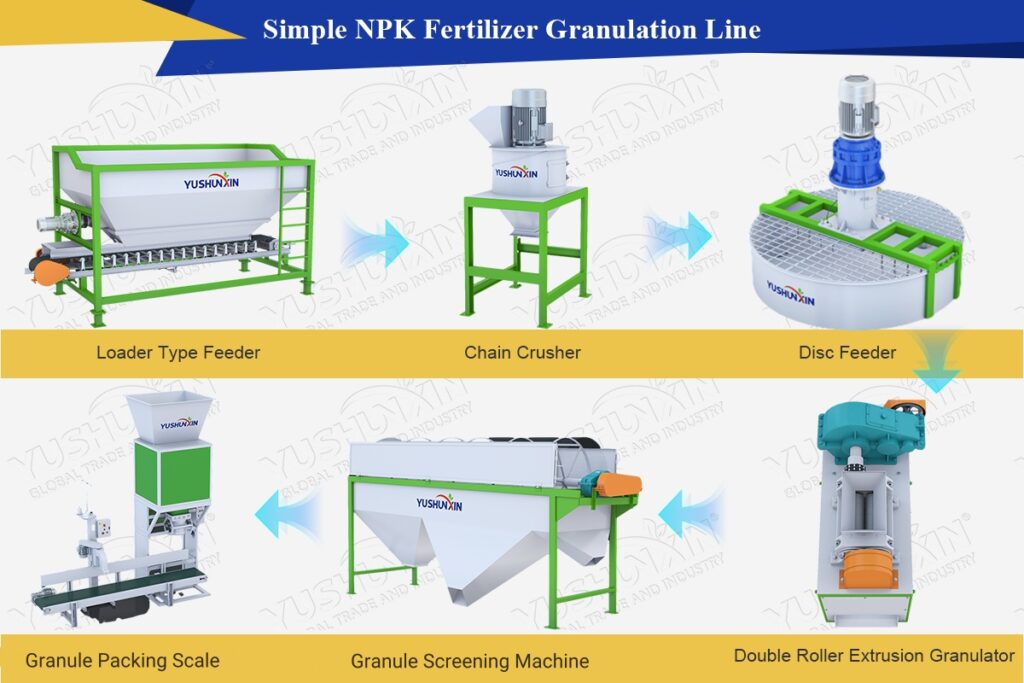
Modern lime fertilizer production lines combine several types of machinery to guarantee efficiency. A loader-type feeder ensures stable raw material supply, while a chain crusher reduces oversized lime rock into fine powder. A horizontal mixer creates balanced blending among limestone, gypsum, and other additives before extrusion. The double roller extrusion granulator acts as the core machine, pressing raw powders into compacted granules without external binders.

Rotary screening equipment then separates qualified pellets from undersized particles, while belt conveyors connect each procedure smoothly. An automatic packaging scale completes the process by ensuring precise bagging of finished products. These machines together create stable production procedures, with minimum labor demand and reduced energy consumption. For industries focusing on lime powder fertilizing particle preparation, such integrated machinery ensures efficient granulating performance and reliable product consistency.


Conclusion

Dry granulation technology provides clear benefits for lime-based fertilizer producers. Each raw material, whether limestone, lime powder, or dolomite, finds suitable transformation into high-quality fertilizer granules. The procedure reduces costs, saves energy, and ensures durable particles. Equipment innovation, including double roller extruders, screening systems, and automated packaging machinery, further strengthens process reliability.

The future of limestone fertilizer granulation lies in sustainable dry extrusion methods, which align with industrial demands for efficiency and environmental responsibility. As a professional fertilizer equipment manufacturer, Yushunxin continues to provide advanced dry granulation machinery and integrated lime fertilizer production solutions that support enterprises in achieving stable output and long-term competitiveness. You can visit: https://www.extruder-granulator.com/product/limestone-powder-granulation-machine/

The Impact of Pelletizing Processes on the Performance of Limestone-Based Fertilizer Granules

In the modern fertilizer industry, the process of transforming raw materials—especially limestone, lime rock, and lime powder—into granular fertilizers has become increasingly sophisticated. The choice of pellet making technique can significantly affect the final fertilizer’s quality, efficiency, and suitability across various industrial sectors. Understanding how pelletizing procedures influence lime-based fertilizer effectiveness is essential for manufacturers aiming to optimize production and deliver value to their customers.


What Raw Materials Suit Limestone Fertilizer Granule Manufacturing and How Do Different Industries Benefit?

Limestone fertilizers derive from several raw materials, including lime rock, finely ground limestone powder, hydrated lime, dolomite, and other calcium-containing minerals. Each type serves specific applications and offers distinct advantages depending on the industry. For example, lime powder remains popular in soil amendment products due to its rapid solubility and high reactivity, making it suitable for environmental remediation and water treatment facilities. Meanwhile, fertilizer producers in the chemical sector often select dolomite for its balanced calcium and magnesium content, which supports tailored nutrient management in industrial-scale formulations.

Limestone Powder Granulator

Different industries—such as environmental management, horticulture, and livestock waste treatment—demand unique properties in their lime-based fertilizer granules. Environmental businesses value fast-dissolving particles for neutralizing acidic waste, while horticultural enterprises prefer slow-release lime pellets that maintain steady soil pH in greenhouses. Precision in selecting and preparing these raw materials ensures that each sector receives a product optimized for its operational needs, and successful pellet formation heavily depends on the starting material’s purity, moisture content, and particle size.


How Do Pelletizing Techniques Affect the Quality and Performance of Limestone Fertilizer Particles?

Granulation methods for limestone fertilizers include several distinct procedures: dry granulation by double roller extrusion, ball making through drum pelletizers, powder pelletizing with rotary granulators, and particle compaction using high-pressure presses. Each method shapes the final granule’s physical characteristics and, ultimately, its performance in various environments.

Dry granulation via double roller extrusion granulators compacts powdered materials into uniform pellets without the need for added moisture, producing dense, dust-free particles ideal for automated spreading equipment. Pelletizing with rotary drum granulators, conversely, yields rounder, more porous particles that dissolve steadily, often used in horticultural and landscaping applications. Ball making devices further enhance structural integrity and resistance to abrasion, essential for bulk handling and transportation.

The pelletizer’s configuration, compaction pressure, and feedstock blending ratios all play critical roles in determining the limestone fertilizer’s solubility, release rate, and mechanical durability. Variations in the granulation process result in pellets with different size distributions, hardness, and nutrient dispersion profiles. By customizing these parameters, manufacturers can address the specific demands of their target industries and maximize the functional benefits of limestone-based fertilizers.


What Machinery Supports Efficient Limestone Fertilizer Granule Production and What Features Should Users Consider?

Efficient production of limestone fertilizer pellets relies on a coordinated system of advanced machinery. The process typically begins with a loader type feeder, which ensures a consistent supply of lime rock or other raw materials to the production line. A crain crusher subsequently reduces the feedstock to the desired particle size for effective mixing and compaction.

Horizontal mixers blend limestone powder with other necessary additives, achieving homogeneity prior to granulation. The double roller extrusion granulator then uses mechanical pressure to form uniform pellets in a dry process, minimizing energy use and product loss. Rotary screening machines sort the finished granules by size, removing fines and oversize particles to maintain product quality, while belt conveyors efficiently transport materials between steps. For final packaging, automatic packaging scales streamline bagging operations, reducing manual labor and enhancing accuracy.

When selecting equipment, users should consider factors such as machine durability, automation capabilities, output capacity, and compatibility with various limestone forms. Appropriate machinery ensures that the entire production and pelletizing process remains efficient, cost-effective, and adaptable to changes in market or regulatory demands.


Conclusion

Ultimately, the effectiveness of lime-based fertilizer products depends on an integrated approach combining the right raw materials, suitable pellet making techniques, and optimized production machinery. By aligning these factors with industry-specific requirements, businesses can produce high-quality limestone fertilizer pellets that deliver superior performance and value.

For those seeking reliable solutions and expert support in limestone fertilizer granule production, a professional fertilizer equipment manufacturer such as Yushunxin offers a comprehensive range of advanced machinery, technical guidance, and customization options to help you achieve your operational goals. Making the right choice at every stage of the process ensures that your fertilizer products meet the evolving needs of diverse industries, supporting both efficiency and sustainability. You can visit: https://www.extruder-granulator.com/product/limestone-powder-granulation-machine/

How to Produce Limestone Powder Granules?

In the realm of industrial production, the transformation of limestone powder into granules is a process that holds substantial significance. This operation not only facilitates easier handling and application of the material but also enhances its utility in various sectors. This discussion delves into the methodologies and machinery involved in this conversion, aiming to provide a thorough understanding for those interested in establishing an efficient production line.

Understanding the Raw Material: Limestone Composition and Preparatory Steps

Before embarking on the granulation process, one must recognize the characteristics of the primary raw material: limestone. Predominantly composed of calcium carbonate (CaCO3), limestone possesses qualities that necessitate specific preparatory measures. Initial processing involves pulverization to achieve a fine powder state, which serves as the baseline for subsequent granulation. Pre-treatment may also include moisture adjustment and segregation of impurities to ensure an optimal starting material for granulation.

Making Rock Phosphate, Limestone, And Dolomite Pellets by Dry Granulator

The Role of Granulation Equipment in Limestone Powder Processing

Central to the transformation of limestone powder into granules is the deployment of sophisticated equipment. A pivotal machine in this operation is the double roller extrusion granulator, which employs dry granulation technique—bypassing the need for binder materials. This machine exerts pressure on the limestone powder, compacting it into uniform granules. The significance of this equipment lies in its efficiency and ability to produce granules with consistent size and shape, which are crucial for the material’s subsequent applications.

Why Incorporate a Horizontal Mixer and Vertical Crusher in Your Production Line?

For a production line aiming at superior quality limestone granules, the inclusion of a horizontal mixer and a vertical crusher becomes indispensable. The horizontal mixer ensures thorough blending of limestone powder before granulation, promoting uniformity in the final product. On the other hand, the vertical crusher plays a crucial role in size reduction and homogenization of the raw material. These machines, when combined, contribute to a streamlined process flow, enhancing the overall efficiency and output quality of the granulation line.

Simple NPK Fertilizer Granulation Line

Enhancing Production Line Efficiency: The Importance of Equipment Selection

Selecting the appropriate machinery is paramount for achieving an optimal production line for limestone granules. Equipment such as double roller extrusion granulators, horizontal mixers, and vertical crushers should be chosen based on their performance, durability, and compatibility with the limestone processing requirements. Furthermore, attention should be given to the scalability and flexibility of the equipment to accommodate future expansion needs and variability in production demands.

Conclusion

The journey from limestone powder to granules involves meticulous planning, understanding of the material properties, and the strategic deployment of specialized equipment. By prioritizing the selection of high-performance machinery and adhering to best practices in material preparation and process execution, one can establish a robust production line. It is in this context that Yushunxin emerges as a professional manufacturer of fertilizer equipment, offering solutions that cater to the intricate needs of limestone granulation. Their expertise and product offerings represent a valuable asset for those aspiring to excel in the production of limestone granules. You can visit: https://www.extruder-granulator.com/limestone-powder-granulation-machine/

How to Make Limestone Pellets in Double Roller Granulator?

Introduction: Understanding Limestone Pellets

Limestone pellets are a popular form of limestone used in various industries, such as agriculture, construction, and environmental applications. These pellets are created by compressing powdered limestone into compacted pellets that are easier to handle and transport. The double roller granulator is a common machine used in the pelletizing process. In this guide, we will take you through the step-by-step process of making limestone pellets using a double roller granulator.

limestone granules
limestone granules

Step 1: Prepare the Raw Materials

To begin the pellet-making process, you need to gather the necessary raw materials. The primary ingredient is powdered limestone, which should have a consistent particle size and be free of impurities. It’s important to ensure that the limestone powder meets the required specifications for pelletizing.

Step 2: Adjust the Moisture Content

The moisture content of the limestone powder plays a crucial role in the pelletizing process. It affects the pellet formation, strength, and overall quality. Ideally, the moisture content should be around 8-12%. If the limestone powder is too dry, you can add water to achieve the desired moisture level. Conversely, if it is too wet, you can use a drying process to reduce the moisture content.

Step 3: Set Up the Double Roller Granulator

The double roller granulator consists of two parallel rolls that rotate in opposite directions. These rolls exert pressure on the limestone powder, shaping it into pellets. Before you start the granulation process, you need to set up the double roller granulator. Adjust the distance between the two rolls based on the desired pellet size. The speed of the rolls can also be adjusted according to specific requirements.

Step 4: Feed the Limestone Powder

Once the double roller granulator is properly set up, you can begin feeding the limestone powder into the machine. The powder is evenly distributed on the rolls, and as they rotate, it is compacted and shaped into pellets. The pressure exerted by the rolls ensures the formation of well-formed and uniform pellets.

Step 5: Adjust the Pressure and Roll Gap

During the pelletizing process, it’s important to monitor the pressure exerted by the rolls and the gap between them. Adjusting the pressure and roll gap can help control the size, density, and hardness of the limestone pellets. Higher pressure and smaller roll gap result in denser and harder pellets, while lower pressure and larger roll gap produce lighter and softer pellets.

Step 6: Collect and Screen the Pellets

As the pellets are formed, they are discharged from the double roller granulator. Collect the pellets and transfer them to a screening machine. The screening process helps remove any oversized or undersized pellets, ensuring a consistent size distribution. This step is crucial for obtaining high-quality limestone pellets with uniform properties.

Step 7: Cure the Pellets

Curing the pellets for a specific period allows them to harden and stabilize, making them suitable for storage and transportation.

Step 8: Packaging and Storage

Once the limestone pellets are properly dried and cured, they are ready for packaging and storage. Use appropriate packaging materials to ensure the pellets remain intact during handling and transport. Store the packaged pellets in a dry and controlled environment to maintain their quality and prevent moisture absorption.

Conclusion: Producing High-Quality Limestone Pellets

By following these steps, you can produce high-quality limestone pellets using a double roller granulator. Remember to start with suitable limestone powder, adjust the moisture content, and set up the granulator correctly. Monitoring and adjusting the pressure and roll gap during the granulation process is essential for obtaining pellets with the desired characteristics. Finally, screen, dry, cure, package, and store the pellets appropriately to ensure their long-term usability. With proper attention to detail and adherence to the process, you can successfully create limestone pellets that meet the required specifications for your specific applications.