
Building a commercial fertilizer factory requires careful planning of production capacity, raw material handling, equipment selection, and investment control. A 10 tons per hour bulk blending fertilizer plant is suitable for medium-scale fertilizer manufacturers who want flexible production, accurate formulation, and efficient operation. A complete 10tph Bulk Blending Fertilizer Factory solution helps investors design a practical production system based on fertilizer demand, available space, and future expansion plans.
Unlike chemical fertilizer production, bulk blending mainly combines different granular fertilizer materials through precise weighing and mixing. This makes the process simpler, reduces production complexity, and allows manufacturers to produce different NPK formulas according to market requirements.
10tph Bulk Blending Fertilizer Production Process
The 10tph bulk blending fertilizer production process usually starts with raw material storage and ends with finished fertilizer packaging. The complete workflow includes several important steps:
1. Raw Material Storage and Feeding
Common raw materials include urea, ammonium phosphate, potassium chloride, and other granular nutrients. Different materials are stored separately to prevent contamination and maintain stable feeding.
Automatic feeding systems transport materials from storage bins to weighing units. Accurate dosing is important because the final fertilizer formula depends on the proportion of each component.
2. Automatic Batching and Weighing
The batching system controls the amount of each fertilizer ingredient according to the selected formula. Modern systems use electronic weighing equipment and control software to improve accuracy and reduce manual operation.
A stable batching process ensures that every production batch has consistent nutrient distribution.
3. Mixing and Blending
After weighing, materials enter the fertilizer blender. The mixer combines different fertilizer particles evenly while maintaining the original granule shape.
The blending system should provide high mixing efficiency while avoiding excessive crushing, because damaged particles may affect fertilizer quality and transportation performance.
4. Screening and Packaging
After mixing, the finished fertilizer is transported to the packaging system. Automatic bagging equipment can improve production efficiency and reduce labor requirements.
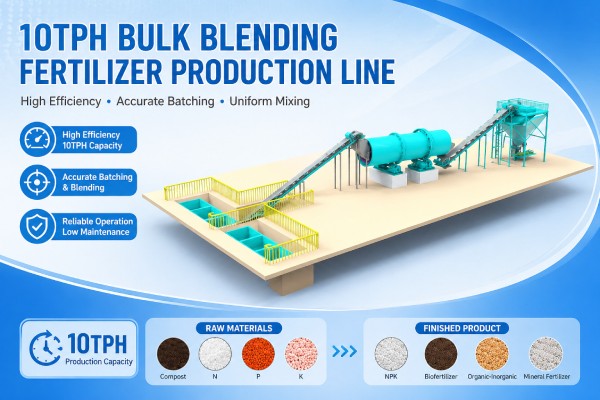
Equipment Required for a 10tph Bulk Blending Fertilizer Factory
The main production equipment determines the reliability and efficiency of the fertilizer plant. The equipment required for a 10tph bulk blending fertilizer factory normally includes:
- Raw material storage bins
- Automatic feeding conveyors
- Electronic weighing and batching system
- Fertilizer blending machine
- Bucket elevators and belt conveyors
- Finished product storage hopper
- Automatic packaging machine
- Electrical control system
For large commercial projects, manufacturers may also provide dust collection systems, additional storage facilities, and customized layouts according to factory conditions.
Investment Cost for a 10tph Bulk Blending Fertilizer Plant
Before starting a fertilizer project, investors need to evaluate equipment costs, factory construction, installation, and operation expenses. The 10tph BB fertilizer production line investment cost depends on equipment configuration, automation level, raw material storage requirements, and local installation conditions.
A basic blending plant usually requires lower investment compared with granulation fertilizer production because it does not need drying, cooling, or granulation equipment. However, selecting reliable equipment is important because production stability directly affects long-term operating profit.
Investors should also consider future expansion possibilities. A well-designed plant can reserve space for additional storage bins or upgraded automation systems. Get more details.
Choosing a Reliable Fertilizer Production Partner
Selecting the right supplier is a key step in building a successful fertilizer project. A professional bulk blending fertilizer production line supplier should provide not only machines but also technical support, production design, installation guidance, and after-sales service.
A complete project partner can help analyze raw materials, recommend suitable equipment configurations, and optimize the production layout.
A turnkey 10tph bulk blending fertilizer factory solution allows investors to receive a complete service from initial planning to equipment installation and commissioning. This approach reduces communication problems and helps ensure that the factory operates smoothly after completion.
Conclusion
A 10tph bulk blending fertilizer factory provides an efficient solution for companies entering commercial fertilizer production or expanding existing capacity. With proper process design, suitable equipment, and professional technical support, investors can build a flexible fertilizer plant that meets changing market demands.
Before purchasing equipment, it is important to evaluate production goals, fertilizer formulas, investment budget, and future development plans. A customized factory solution can help achieve stable production and better long-term returns. If you are interested in the project, you can visit https://www.mixedfertilizermachines.com/products/10tph-bulk-blending-fertilizer-factory/