The Role of Pan Granulation in Converting Ore to Fertilizer Particles

Mineral-based fertilizers play a critical role in modern industrial and environmental applications. The transformation of mined ore materials into uniform fertilizer particles requires a precise and efficient production method. Pan granulation, also known as disc granulation, provides such a pathway by enabling the controlled conversion of fine mineral powders into dense, spherical granules. This process connects the mining, chemical, and material-handling industries through a unified production system. When ore materials undergo granulating procedures, they acquire higher bulk density, improved flowability, and enhanced reactivity, all of which are essential for further industrial use or market distribution.


What Types of Ore Materials Are Suitable for Fertilizer Granulation?

Different mineral resources support the manufacturing of various mineral fertilizer products. Phosphate rock, for example, serves as a primary material in rock phosphate fertilizer production where granulation improves solubility and nutrient availability. Limestone and dolomite provide calcium-based minerals for limestone fertilizer production solutions and for blending in NPK fertilizer lines. Iron ore dust or mine tailings can also become part of mineral organic fertilizer production lines or mine waste management projects, where granulation stabilizes the fine particles and reduces environmental risks.

Each raw material requires specific preparation steps. Crushing machines, such as a jaw rock crusher or ore fertilizer crusher machine, reduce the mined ore into smaller particles. Grinding equipment like a Raymond mill can refine the particle size before granulation. These pre-processing stages ensure consistent feeding for the pan granulator and uniform granule formation. Industries that handle mining residues or mineral additives can also benefit since granulation facilitates transportation, dust reduction, and controlled nutrient release.

Disc Pelletizer for Rock Fertilizer Making

How Does Pan or Disc Granulation Function in Ore Fertilizer Manufacturing?

The pan granulation process relies on a rotating disc or pan granulator that continuously mixes and agglomerates mineral powders with controlled moisture and binder addition. The rotation of the disc creates a rolling bed of particles, allowing fine ore dust to coalesce into uniform spherical granules. In mineral fertilizer manufacturing, this principle ensures that each particle maintains mechanical strength and homogeneous mineral composition.

A disc granulation machine allows flexible control over granule size by adjusting the pan tilt angle, rotational speed, and water spray volume. This flexibility suits varying mineral fertilizer production demands, whether for rock-based phosphate materials or blended NPK fertilizers. Unlike other granulating approaches, pan granulators operate with lower energy consumption and simpler maintenance procedures. When integrated with a screening machine, the production line can classify granules by size, recycle the undersized materials, and achieve a closed-loop manufacturing process.


What Are the Benefits of Using Pan Granulation for Mineral Fertilizer Processing?

Pan granulation offers multiple technical and economic advantages. The granulating process converts fine mineral powders into manageable pellets, reducing dust emissions and material loss during handling. The resulting fertilizer particles exhibit stable size distribution and improved strength, making them suitable for storage, packaging, and industrial blending. Furthermore, the disc granulator system supports continuous operation and requires less floor space compared with large drum pelletizers.

In addition, pan granulation enhances the value of low-grade ores. Through controlled moisture and chemical adjustment, even marginal mining residues can turn into useful fertilizer materials. This process supports sustainable mine waste management while lowering raw material costs. The integration of granulation machinery with crushing, screening, and drying equipment creates a complete mineral fertilizer manufacturing line that serves both mining enterprises and chemical fertilizer producers.


Conclusion

The transformation of ore-based minerals into high-quality fertilizer particles depends on precise granulation technology. Pan or disc granulators enable mining and processing industries to convert fine mineral materials into durable, uniformly sized granules that meet diverse production requirements. By integrating crushing machines, granulators, and screening systems, enterprises can build efficient mineral fertilizer production lines and achieve sustainable use of mining resources.

A professional fertilizer equipment manufacturer—Yushunxin—provides reliable pan granulation solutions and complete mineral fertilizer production machinery, supporting clients in achieving stable, efficient, and environmentally responsible fertilizer manufacturing. You can visit: https://www.mineralfertilizerproductionsolutions.com/product/disc-granulator-machine/
How Do Disc Granulators Aid in Producing High-Quality Fertilizer Granules from Mineral Resources?

The production of mineral-based fertilizers requires stable granulation technology and precise control of raw material characteristics. In the mining and chemical industries, the conversion of rock, ore, and mineral powders into uniform fertilizer granules determines both the product quality and the efficiency of downstream applications. Among various granulating technologies, disc granulators—also known as pan granulators or pelletizers—play a central role in ensuring the consistency, strength, and nutrient balance of mineral fertilizer products.


What Types of Mineral Raw Materials Suit Fertilizer Granulation and How Do They Serve Different Industries?

Mineral fertilizer production relies on abundant natural resources such as phosphate rock, limestone, dolomite, potassium ore, and gypsum. Each mineral provides specific benefits and meets distinct industrial needs. For instance, rock phosphate supports the manufacturing of phosphate-based fertilizers, which supply essential phosphorus for soil improvement and industrial chemical processing. Limestone and dolomite are widely used in limestone fertilizer production solutions, enhancing calcium and magnesium content while neutralizing soil acidity in both agricultural and environmental projects. Meanwhile, potassium ore serves as the foundation for NPK fertilizer production, contributing to balanced nutrient formulations required in high-value crops and industrial compound fertilizers.

Disc Pelletizer for Rock Fertilizer Making

In the mine waste management field, mineral residues from ore extraction often contain valuable nutrients. Through proper crushing, granulating, and classification, these residues transform into effective mineral organic fertilizer granules, reducing waste and improving resource utilization. The diversity of raw materials demands adaptable machinery that can process minerals of different hardness, moisture levels, and particle sizes.


How Do Disc Granulators Operate in the Mineral Fertilizer Manufacturing Process?

A disc granulation machine performs a continuous and controlled process that converts mineral powders into uniform granules. During operation, the rotating pan creates a rolling bed of material, where fine particles adhere and grow layer by layer. This dynamic rolling mechanism allows precise control of particle size distribution. The adjustable disc angle, rotational speed, and moisture regulation system enable consistent granule formation suitable for various mineral compositions.

In many mineral fertilizer production lines, the disc granulator works alongside other essential equipment. An ore fertilizer crusher machine or jaw rock crusher prepares the raw mineral feed by reducing particle size and increasing surface area. A screening machine sorts the finished granules based on size requirements, ensuring uniformity before packaging or further processing. Some systems also include a drying or cooling unit to stabilize granules for storage and transport.

The integration of a pan-type pelletizer within the production process not only improves mechanical strength and shape uniformity but also enhances nutrient release control. This consistency ensures stable product quality across phosphate, limestone, or complex mineral fertilizers.


Why Do Mineral-Based Fertilizer Plants Prefer Disc Granulation Systems?

Disc granulators meet the core industrial requirement for efficient, clean, and adjustable granulation. Compared with other pelletizing technologies, this equipment offers better control of granule diameter and higher yield for fine mineral powders. The open structure of the pan enables easy observation, maintenance, and operation. In addition, the granulating mechanism consumes less power and minimizes material loss during the rolling and layering process.

The reliability of disc-type granulators makes them suitable for multiple fertilizer manufacturing scenarios, such as rock phosphate fertilizer production, bulk fertilizer blending plants, and mineral organic fertilizer production lines. These systems demand stable granule quality, high processing capacity, and compatibility with different chemical additives or mineral modifiers. By applying a disc granulator system, an enterprise gains consistent production output and improved product competitiveness.


How Can Manufacturers Enhance the Efficiency of Mineral Fertilizer Granulation?

To achieve high-quality mineral fertilizer granules, a manufacturer must combine accurate material preparation with stable granulation control. Proper crushing, moisture conditioning, and uniform feed distribution ensure balanced granule growth within the disc. Continuous monitoring of granule size and density further improves the efficiency of the production line. When coordinated with efficient drying, cooling, and screening systems, the overall granulating process reaches both technical and environmental optimization.


Conclusion

The process of transforming raw rock, ore, and mineral materials into durable fertilizer granules requires integrated mechanical and process design. A disc granulator serves as the core of this transformation, connecting crushing, granulating, and screening operations into a continuous production flow. Through precision control and durable structure, this equipment helps fertilizer producers generate uniform, high-strength granules from diverse mineral resources.

A professional fertilizer equipment manufacturer—Yushunxin—offers advanced disc granulators and complete mineral fertilizer production lines that support phosphate, limestone, and mixed mineral applications. Its engineering solutions ensure efficient granulation, stable output, and reliable performance in modern mineral fertilizer manufacturing. You can visit: https://www.mineralfertilizerproductionsolutions.com/product/disc-granulator-machine/
How Do Pan Granulating Machines Enhance Rock Fertilizer Manufacturing Efficiency?

In the modern mineral fertilizer industry, the production of high-quality granules from rock-based raw materials requires precise machinery and carefully designed processing solutions. Pan granulating machines, also called disc granulators or pelletizers, play a central role in transforming mineral powder into uniform fertilizer particles. By integrating pan granulation with other equipment such as ore fertilizer crushers and screening machines, manufacturers can achieve stable output, efficient resource utilization, and consistent granule quality.


What Types of Rock and Mineral Raw Materials Suit Fertilizer Granulation?

Rock-based raw materials form the backbone of mineral fertilizer manufacturing. Rock phosphate, dolomite, limestone, gypsum, and potassium-bearing ores represent common feedstocks for granule preparation. For example, rock phosphate supports phosphate fertilizer production by providing a natural source of P elements. Limestone contributes to neutralization in soil amendment products and integrates effectively into limestone fertilizer production solutions. Potassium feldspar and similar ores enable the preparation of potassium-rich particles for multiple industrial uses beyond agriculture.

Each mineral raw material has specific granulation needs. Rock phosphate powder requires fine crushing with a jaw rock crusher or Raymond mill before granulating. Limestone often needs controlled moisture adjustment during the pelletizing process to ensure strong ball formation. Gypsum requires uniform mixing and disc pelletizing to achieve consistent particle strength. By understanding these raw material characteristics, manufacturers can design targeted granulation procedures that minimize waste and enhance productivity.

Disc Pelletizer for Rock Fertilizer Making

Why Do Different Industries Benefit from Rock Fertilizer Granule Manufacturing?

The mineral fertilizer sector serves more than agricultural purposes. In mining waste management, granulation converts fine ore waste into usable particles that reduce dust and improve handling. In the chemical industry, phosphate granules serve as feedstock for advanced material production. In construction-related fields, limestone and gypsum granulation deliver particles for soil stabilization and environmental remediation projects. Each industry requires stable granule size, controlled hardness, and precise composition.

Granule manufacturing allows industries to transport, store, and apply mineral-based products with greater efficiency. Uniform particle size from disc or pan granulation machines reduces segregation during bulk fertilizer blending plant operations. Stable hardness ensures that granules withstand mechanical stress during loading and shipping. Properly designed fertilizer granules also improve dissolution rates in multiple application scenarios, which benefits both industrial and environmental projects.


How Do Pan Granulating Machines Improve the Mineral Fertilizer Process?

Pan granulating machines transform mineral powder into strong granules through a rotating disc system. The adjustable angle of the disc surface controls granule size distribution, which allows manufacturers to produce small particles or larger pellets based on market demand. The wet granulation method enables powders such as phosphate rock dust or dolomite fines to bind together under controlled moisture, forming uniform fertilizer granules.

Disc granulators also support flexible integration with other equipment. An ore fertilizer crusher machine prepares fine powders, while a screening machine separates qualified pellets from oversized or undersized materials. Oversized granules return for further crushing and re-granulation, and undersized particles re-enter the pelletizing procedure. This closed-loop process reduces waste and increases yield. Furthermore, operators benefit from low energy consumption, simple operation structure, and stable performance during continuous production.


How Can Pan Granulation Support Different Fertilizer Production Lines?

Pan granulating machinery fits into various mineral fertilizer production solutions. In rock phosphate fertilizer production, disc pelletizers create uniform phosphate particles ready for further processing. In NPK fertilizer manufacturing, pan granulation prepares individual mineral components before blending and coating. In mineral organic fertilizer production lines, disc granulators combine organic matter with crushed ore materials to form balanced composite particles. These applications demonstrate the adaptability of pan granulation systems across multiple mineral industries.

The ability to granulate diverse raw materials, handle complex formulations, and integrate with crushers, mixers, and screeners makes pan granulators essential equipment in rock fertilizer manufacturing. Their application ensures that mineral resources transform into consistent, market-ready products that meet industry standards.


Conclusion

The use of pan granulating machines brings significant advantages to rock fertilizer production. By converting mineral powders such as phosphate rock, limestone, and gypsum into durable fertilizer granules, manufacturers achieve efficient resource use, stable quality, and expanded industrial applications. Integration with ore fertilizer crushers, Raymond mills, and screening equipment further optimizes the manufacturing procedure.

A professional fertilizer equipment manufacturer like Yushunxin provides complete solutions for mineral fertilizer production lines, combining disc granulators with supporting machinery to deliver reliable, efficient, and sustainable outcomes for the rock fertilizer industry. You can visit: https://www.mineralfertilizerproductionsolutions.com/product/disc-granulator-machine/

How Do Disc Granulation Machines Facilitate the Production of Granular Fertilizer from Rocks?

Modern fertilizer production processes increasingly rely on advanced machinery to convert raw mineral materials into uniform, high-quality granules. Among these, disc granulation machines—also known as pan granulators or disc pelletizers—play a central role in transforming various mined rocks and ores into valuable fertilizer particles. Mineral fertilizer granule production involves precise engineering and controlled processing steps; therefore, it is crucial to understand how disc pelletizing technology supports the needs of different resource sectors.


What Raw Materials Are Suitable for Mineral Fertilizer Granule Production, and How Do Different Industries Benefit?

A wide range of rocks and minerals serve as primary materials for mineral fertilizer manufacturing. For example, phosphate rocks remain the foundation of phosphate fertilizer production. When processed and granulated, these mineral particles provide essential nutrients, meeting the needs of the chemical and fertilizer industry for high-phosphate products. Similarly, limestone and dolomite from mining operations become vital sources for calcium- and magnesium-based fertilizers, supporting the steel and glass industries by offering byproduct management options and value-added material utilization.

Industries dealing with potash ore extraction also benefit from advanced pellet making processes, as potash-based fertilizers require precise granulation for effective plant application and distribution. In addition, mine waste management facilities increasingly seek pelletizing solutions to repurpose mineral residues—including tailings and byproduct fines—into marketable fertilizer particles. Each of these sectors demands reliable mineral granulation machinery to optimize yield, control dust, and improve product performance.

Disc Pelletizer for Rock Fertilizer Making

How Do Disc Granulation Machines and Related Equipment Transform Rocks into Fertilizer Granules?

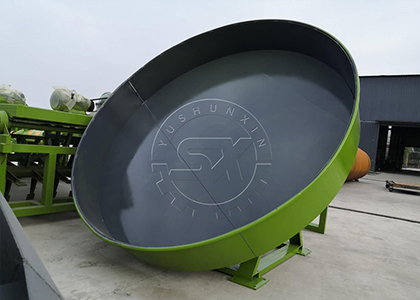
During mineral fertilizer granules preparation, disc granulators act as core equipment for agglomerating fine mineral powders into uniform pellets. The pan granulator features an inclined rotary disc, which ensures consistent rolling and layering of raw ore particles combined with liquid binders. This unique structure allows for precise control over pellet size, shape, and moisture content, making disc pelletizers highly adaptable for different mineral compositions.

When a mineral fertilizer production solution includes ores with varying hardness or particle size, a preparation stage often employs an ore fertilizer crusher machine, such as a jaw rock crusher or a Raymond mill. These crushing machines reduce raw rocks and minerals to the optimal powder size for subsequent granulation. After granule formation in the disc pelletizer, a screening machine separates qualified fertilizer pellets from oversized or undersized particles, ensuring a uniform end product.

Disc granulating machines integrate seamlessly with complete mineral organic fertilizer production lines, rock phosphate fertilizer production processes, and bulk fertilizer blending plants. Their modular design accommodates capacity expansion, making them suitable for both large-scale mine waste management projects and specialized mineral fertilizer production needs.


What Are the Main Features and Advantages of Disc Pelletizers in Mineral Granule Manufacturing?

Disc granulators provide several key advantages in mineral fertilizer granulation. Their adjustable inclination angle and rotational speed enable precise granular size control, which is critical for the manufacturing of NPK fertilizer and other multi-component mineral products. The open structure of the pan machine allows for real-time observation and easy cleaning, reducing material cross-contamination during mine-derived fertilizer preparation.

Additionally, disc pelletizing equipment features robust structural components to withstand continuous operation with abrasive mineral materials. High wear resistance and simple maintenance lower downtime and operational costs, addressing the efficiency and reliability requirements of mining and mineral processing sectors. When integrated with auxiliary machinery, such as ore fertilizer crusher machines and screening equipment, pan granulators form the backbone of efficient and sustainable mineral fertilizer manufacturing solutions.


Conclusion

In summary, disc granulation machines and supporting mineral fertilizer processing equipment enable efficient transformation of diverse rocks, ores, and mine residues into valuable granular fertilizer products. Industry professionals benefit from tailored solutions that optimize raw mineral utilization, improve granule quality, and streamline production workflows. For advanced mineral granule manufacturing projects, a professional fertilizer equipment manufacturer such as Yushunxin can provide comprehensive solutions and expert technical support to meet industry-specific requirements. You can visit: https://www.mineralfertilizerproductionsolutions.com/product/disc-granulator-machine/

How to Make NPK Granules?

NPK granules play a crucial role in the agricultural industry by providing plants with the essential nutrients needed for growth. NPK stands for Nitrogen, Phosphorus, and Potassium, the three key components in fertilizers. Let’s explore the different methods of producing NPK granules and highlight the advantages of each technique.

Wet Granulation Technology

Among the various methods available, wet granulation is one of the most widely used approaches for NPK granule production. This process involves combining NPK raw materials with water to form a wet mixture. The mixture is then passed through a granulator, where it is shaped into granules. Two common types of granulators utilized in this process are the drum granulator and the disc granulator.

NPK Fertilizer Granulators

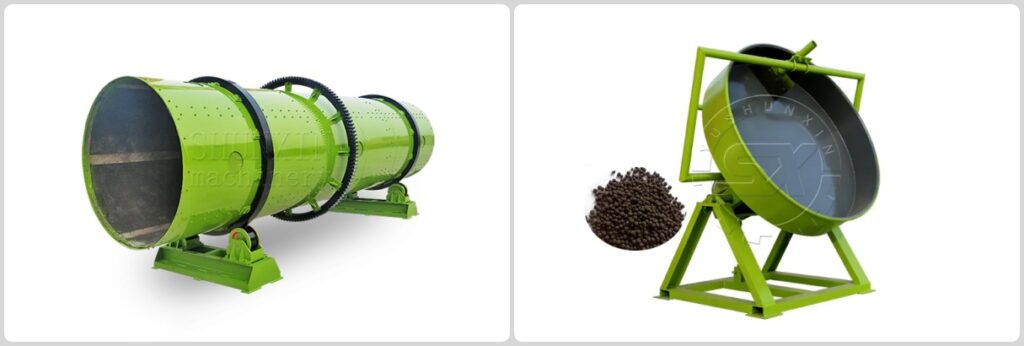
The drum granulator features a large rotating drum that applies a tumbling action to form the granules. On the other hand, the disc pelletizer utilizes a spinning disc to achieve the same result. Both machines are highly efficient and capable of producing high-quality NPK granules. Notably, Shunxin’s NPK granulation machines are specifically designed to handle the wet mixture and shape it into uniform-sized granules.

Dry Granulation Technology

Dry granulation technology, in contrast, involves compacting the raw materials without the addition of liquid. This method is particularly suitable for materials that are sensitive to moisture or heat. SX double roller press granulator is a perfect choice for NPK dry granulation. This granulator employs two rollers that press the material into a sheet or ribbon. The sheet is then broken down into granules through a process known as extrusion. The press granulator operates with great efficiency and produces granules with uniform size and shape.

The selection between wet and dry granulation methods depends on several factors, including the characteristics of the raw materials, desired granule properties, and production scale. Regardless of the chosen method, Shunxin’s NPK granulation technlogy are versatile and capable of meeting the requirements of both small and large-scale production. These machines are designed with user-friendliness in mind, featuring easy-to-use controls and maintenance-friendly attributes.

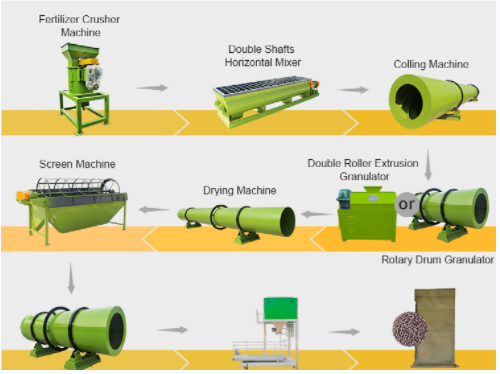
In addition to the granulation machines, Shunxin offers a comprehensive range of equipment that can be used in the production of NPK granules. This includes static batching machines, double shaft mixers, rotary screening machines, packing machines, and palletizer robots. These machines work in harmony to create a complete and efficient production line that ensures reliability and cost-effectiveness.

NPK Granulation Process

In conclusion, the production of NPK granules is a vital process in the agricultural industry, providing plants with essential nutrients for growth. Shunxin’s advanced technology and user-friendly design make wet and dry granulation machines the perfect choices for producing high-quality NPK granules. Whether you’re a small-scale farmer or a large-scale fertilizer producer, Shunxin has the equipment you need to succeed. For more details, please visit this link: https://www.fertilizerproductequipment.com/npk-fertilizer-production-technology/

Chicken Manure Disc Pelletizer

The process of composting chicken manure is a great way to turn waste into a valuable resource for agriculture. However, to get the most out of this process, farmers need to have an efficient and effective way to transform the composted manure into a form that can be easily spread over fields. This is where a chicken manure disc pelletizer comes in.

What is a Chicken Manure Disc Pelletizer?

A chicken manure disc pelletizer is a machine that compresses and shapes composted chicken manure into small pellets. These pellets are an ideal form for spreading over fields as they can be easily distributed, and they provide a slow-release source of nutrients for crops. The disc pelletizer uses a rotating disc that has a series of blades attached to it. As the disc rotates, the blades push the composted chicken manure against a stationary plate. This plate shapes the composted manure into small pellets, which are then discharged from the machine.

Advantages of a Chicken Manure Disc Pelletizer

One of the main advantages of using a chicken manure disc pelletizer is that it creates a uniform product. The pellets are all the same size and shape, which means that they can be spread evenly over a field. This is important as it ensures that crops receive a consistent supply of nutrients. In addition, the pellets are easier to handle than raw composted chicken manure, which can be bulky and difficult to spread.

Another advantage of a chicken manure disc pelletizer is that it helps to reduce odor. Chicken manure can be quite pungent, and the composting process can exacerbate this. However, by compressing the composted chicken manure into pellets, the machine helps to reduce the surface area of the manure, which in turn reduces the amount of odor that is released.

How to Use a Chicken Manure Disc Pelletizer?

Using a chicken manure disc pelletizer is relatively straightforward. First, the composted chicken manure needs to be loaded into the machine. The disc should be set to rotate at the desired speed, and the blades should be adjusted to the appropriate angle. As the machine runs, the composted chicken manure will be pushed against the stationary plate, and small pellets will be formed. These pellets can then be collected and stored until they are ready to be spread over fields. You can learn more to get here.

dic pelletizer for sale

Maintenance of a Chicken Manure Disc Pelletizer

Like any piece of machinery, a chicken manure disc pelletizer requires regular maintenance to ensure that it is functioning correctly. The blades need to be sharpened or replaced periodically, and the machine should be cleaned after each use to prevent the buildup of residue. In addition, it is important to regularly inspect the machine for any signs of wear or damage.

Conclusion

A chicken manure disc pelletizer is an essential tool for any farmer who wants to turn waste into a valuable resource. By compressing composted chicken manure into small pellets, the machine creates a uniform product that can be easily spread over fields. This not only provides a slow-release source of nutrients for crops but also helps to reduce odor. With proper use and maintenance, a chicken manure disc pelletizer can be a highly effective and efficient addition to any farm. If you are interested in this machine , you can visit https://www.granulatorforfertilizer.com/disc-pelletizer-for-sale/.

How to Prepare Granular Fertilizer in Your Disc Granulator Fertilizer Production Line?

Disc granulator fertilizer production line is a widely used method of preparing granular fertilizers. Granular fertilizers are much easier to store and apply than powdered fertilizers. A disc granulator fertilizer production line is a simple and efficient way of producing granular fertilizers. This method is ideal for farmers and agricultural businesses who want to improve crop yield and quality.

Selecting the Right Materials

The first step in preparing granular fertilizer is selecting the right materials. A disc granulator fertilizer making plant can use a wide variety of materials such as nitrogen, phosphorus, and potassium fertilizers. Organic materials such as animal waste, crop residues can also be used. When selecting materials, it is important to consider the nutrient content, particle size, and moisture content. The nutrient content of the materials will determine the final nutrient content of the fertilizer. The particle size and moisture content will affect the granulation process.

Mixing System

Once the materials have been selected, they should be mixed thoroughly. A disc granulator fertilizer production line can use a mixer to combine the materials. The manure mixer should be able to blend the materials evenly and ensure that each particle is coated with the fertilizer. The moisture content of the mixture should be between 25% and 30% to ensure proper granulation.

Feeding the Materials

The mixed materials should be fed into the disc granulator fertilizer production line. The disc granulator is a machine that rotates and rolls the mixture into granules. The disc granulator fertilizer production line can adjust the angle of the disc to control the size and shape of the granules. The size of the granules should be between 2mm and 6mm.

Drying the Granular Fertilizer

After the granules have been formed, they should be dried to remove any excess moisture. The drying process can be done using a rotary dryer or a fluidized bed dryer. The temperature and airflow should be controlled to ensure that the granules are dried evenly and do not become damaged.

Cooling the Granules

Once the granules have been dried, they should be cooled to room temperature. The cooling process can be done using a cooler machine. The cooler machine can reduce the temperature of the granules to prevent moisture buildup and improve storage stability.

Packaging the Fertilizer

The final step in preparing granular fertilizer is bagging the granules. The packaging process can be done using a packaging machine. The packaging machine can weigh and package the granules into bags or containers. The packaging should be airtight to prevent moisture buildup and improve storage stability.

In conclusion, preparing granular fertilizer in a disc granulator fertilizer production line is a simple and efficient way of producing high-quality fertilizer. The key to success is selecting the right materials, mixing them thoroughly, feeding them into the disc granulator, drying and cooling the granules, and packaging them in airtight containers. By following these steps, farmers, gardeners, and agricultural businesses can improve crop yield and quality while reducing waste and improving sustainability.

Click here:https://www.fertilizerproductionproject.com/disc-granulator-fertilizer-production-line/

Email us:info@fertilizerproductionproject.com