
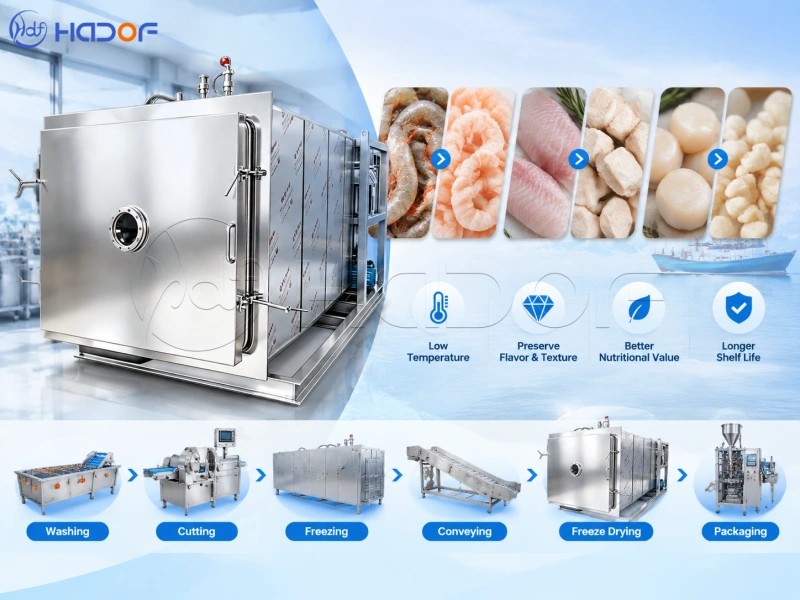
Freeze-Dried Seafood: Preserving Shrimp, Fish and Scallops at Scale
Seafood is one of the most perishable food categories in the world. Shrimp, fish, and scallops lose quality quickly, and their high value makes every day of shelf life count. Freeze drying solves that problem by removing water at low temperature, so the seafood keeps its shape, protein, and flavor while becoming light, shelf-stable, and easy to ship. For processors, a dedicated freeze-dried seafood line turns a perishable raw material into a premium product for soups, ready meals, pet food, and export markets.
Why Freeze-Dry Seafood
Freeze-dried seafood keeps its original structure instead of shrinking or hardening. Because the process runs at low temperature, heat-sensitive proteins and flavors are preserved, and the product rehydrates quickly when water is added back. It is also extremely light, which cuts shipping and storage costs, and it stores for years without refrigeration. For shrimp, fish, and scallops, that combination of quality and convenience supports premium pricing in both retail and foodservice.
Industrial Seafood Freeze Dryer for Shrimp, Fish and Scallops
The Production Process
A commercial seafood line follows a clear sequence:
- Receiving and inspection — fresh seafood is checked for freshness, size, and defects.
- Cleaning and preparation — product is washed, peeled, deveined, or portioned as required.
- Blanching or pretreatment — a controlled heat step can improve color and stability before freezing.
- Freezing — the product is frozen quickly so small ice crystals form and texture is protected.
- Vacuum freeze drying — ice sublimates directly to vapor at low pressure, preserving structure and nutrients.
- Sorting and packaging — dried product is inspected and packed in moisture- and oxygen-barrier packaging.
Each step matters. Poor preparation or slow freezing shows up later as tough texture or uneven drying, so the line must be designed as a system rather than a collection of machines.
Equipment for a Freeze-Dried Seafood Line
The core of the line is the freeze dryer itself. An industrial seafood freeze dryer is designed around the product’s freezing behavior, batch weight, and target moisture. Around it, the line needs washing and preparation equipment, a pre-freezer or tunnel freezer, and a packing machine. If you process several seafood types, the dryer and trays should be flexible enough to handle different piece sizes and cycles.
Capacity is usually specified by batch weight or shelf area. Small and medium producers often start with a batch size in the tens to low hundreds of kilograms, while larger plants use multiple dryers or a continuous configuration. The right choice depends on your raw-material supply, your target output, and how long each product needs in the chamber.
Freeze Drying vs. IQF Freezing
IQF freezing is excellent for keeping seafood frozen, but it still requires a cold chain from plant to customer. Freeze drying goes further: it removes the water, so the product can be stored and shipped at ambient temperature. For premium ingredients and long-distance export, that difference is significant. Our guide to freeze drying vs. IQF freezing explains the trade-offs in more detail.
Sizing a Freeze-Dried Seafood Line
Sizing starts with your raw-material supply. How much fresh shrimp, fish, or scallops can you bring in each day, and how consistent is that supply across the season? The dryer’s batch weight and shelf area should match that supply, not the other way around. A line that is too small leaves product waiting and hurts freshness; a line that is too large runs at low load and wastes energy. Many processors start with one dryer sized to a comfortable daily batch and plan the building, pre-freezing, and packing areas so a second dryer can be added later. That approach keeps the initial investment manageable while leaving room to grow.
Quality Control
Quality control starts with the raw material. Seafood should be fresh, properly chilled, and consistent in size. Blanching times and temperatures must be controlled so the product keeps its color without overcooking. Freezing must be fast enough to protect texture, and the freeze-drying process must be monitored for pressure, shelf temperature, and moisture. Finished product is tested for moisture content, rehydration, color, and microbial safety before packing.
Packaging and Shelf Life
Freeze-dried seafood is hygroscopic, so packaging is critical. Moisture- and oxygen-barrier bags, cans, or pouches protect the product from humidity and oxidation. Nitrogen flushing can further extend shelf life. Correct packaging keeps the product crisp and stable for years, while poor packaging quickly leads to softening and flavor loss.
Market Applications
Freeze-dried shrimp, fish, and scallops appear in instant soups, ready meals, seasoning blends, pet food, and premium snack products. Exporters value the light weight and ambient storage, while foodservice buyers value the fast rehydration and consistent quality. Because the product keeps its original shape, it also works well in premium retail packs where appearance matters.
Common Mistakes to Avoid
The most common mistake is using seafood that is already losing freshness; freeze drying preserves quality but cannot improve it. The second is freezing too slowly, which produces large ice crystals and damages texture. The third is overloading trays, which blocks vapor flow and creates uneven batches. The fourth is under-sizing the condenser, so the cycle slows down and energy use rises. Finally, skipping a proper packaging barrier undoes the benefit of freeze drying within weeks.
Conclusion
Freeze-dried seafood is a high-value product for processors who want to turn perishable shrimp, fish, and scallops into stable, export-ready ingredients. The process is straightforward, but the equipment and process control must be matched to the product. HADOF Food Processing Manufacture designs complete production lines for freeze-dried seafood, from preparation and freezing to the freeze dryer and packaging. Tell us your product and target output, and we will help you plan the right system.